News
The Big Misconception: Tobacco Smoke, E-Cigarette Aerosol, and Nicotine Are Not the Same
22 June, 2026
Key Message
The public often treats cigarettes, e-cigarettes, smoke-free alternatives, and nicotine as one single issue. But they are not the same.
Smoking is uniquely harmful because tobacco is burned and toxic smoke is inhaled. Nicotine is addictive and not risk-free, but it is not the main cause of smoking-related disease. E-cigarettes are also not risk-free, especially for youth and non-smokers. But for adult smokers who switch completely, they are generally understood as less harmful than continuing to smoke.
The real issue is not whether society should care about nicotine. It should. The issue is whether public conversation has become so focused on nicotine that it forgets what made smoking deadly in the first place: combustion.
The Question We Keep Getting Wrong
World No Tobacco Day is meant to sharpen public understanding, not blur it. Yet in many public conversations, cigarettes, e-cigarettes, smoke-free alternatives, and nicotine are often treated as if they belong in the same risk category.
That is where the misconception begins.
Many people hear “anti-tobacco” and assume it also means “anti-nicotine in every form.” But health risk depends heavily on how nicotine is delivered. Nicotine delivered through combustible tobacco smoke is not the same as nicotine delivered through e-cigarette aerosol, oral nicotine products, or regulated cessation therapies such as patches and gum.
WHO’s 2026 World No Tobacco Day theme, “Unmask the appeal – countering tobacco and nicotine addiction,” reflects this broader nicotine landscape. WHO warns that tobacco and nicotine industries design products to keep young people stuck in a cycle of addiction (World Health Organization [WHO], 2026a).
That warning is valid. Flavours, digital marketing, lifestyle branding, and youth-oriented appeal can make nicotine products more attractive to adolescents and non-smokers. But the warning also raises a bigger question: are we helping the public understand the difference between tobacco smoke, e-cigarette aerosol, and nicotine — or are we allowing all three to be collapsed into one fear-based category?
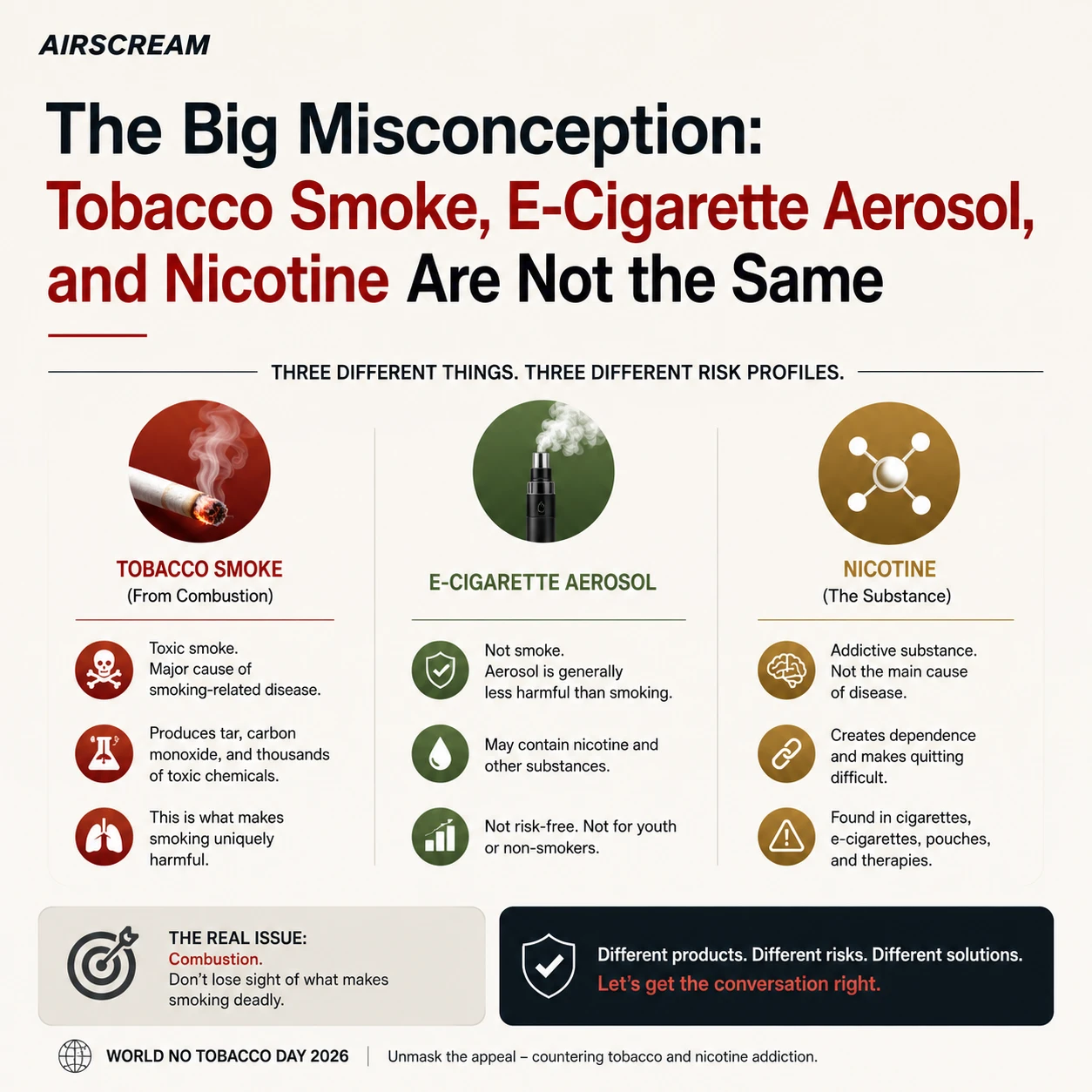
Tobacco Smoke, E-Cigarette Aerosol, and Nicotine Are Not the Same
One of the biggest misunderstandings in the public conversation is the way cigarettes, e-cigarettes, smoke-free products, and nicotine are often placed into one single category. This may sound simple from a policy or social messaging standpoint, but scientifically, the terms are not interchangeable.
Tobacco smoke is produced when tobacco is burned. This is the defining danger of cigarettes. Combustion releases tar, carbon monoxide, and thousands of chemicals, many of which are toxic or carcinogenic. That is why smoking remains the most harmful way to consume nicotine.
E-cigarettes do not produce tobacco smoke. They produce an aerosol, which may contain nicotine and other substances. This does not make vaping harmless, and it does not mean non-smokers or young people should start. But it does mean e-cigarette aerosol should not be described as tobacco smoke, because the mechanism and risk profile are different.
Nicotine is different again. Nicotine is the substance that creates dependence and makes quitting difficult. It can be found in cigarettes, e-cigarettes, nicotine pouches, heated tobacco products, and nicotine replacement therapies. Nicotine is addictive and not risk-free, but it is not the same thing as tobacco smoke.
This distinction matters because when society treats all nicotine-containing products as if they carry the same risk as cigarettes, the conversation becomes misleading. Cigarettes are harmful mainly because tobacco is burned. Nicotine explains why many smokers find it hard to quit; combustion explains why smoking causes such serious disease.
The Combustion Blind Spot
Society has become so focused on nicotine that we are forgetting what made smoking deadly in the first place: combustion.
The U.S. Food and Drug Administration explains that nicotine is what addicts and keeps people using tobacco products, but it is not what makes tobacco use so deadly. The serious disease burden comes largely from the chemical mixture found in tobacco and tobacco smoke (Food and Drug Administration [FDA], 2026).
That distinction should sit at the centre of the discussion.
Nicotine explains dependence. Combustion explains much of the harm.
When tobacco is burned, it produces smoke containing tar, carbon monoxide, and thousands of chemicals. This is what makes smoking uniquely dangerous. If public messaging focuses only on nicotine, it risks turning nicotine into the only villain while making the role of burning tobacco less visible.
This does not mean nicotine should be treated casually. It means public communication should be accurate enough to say two things at once: nicotine addiction matters, and combustion remains the major reason smoking is so harmful.
Nicotine explains why many smokers find it hard to quit. Combustion explains why smoking causes serious disease.
When Stigma Becomes Misinformation
E-cigarettes are often judged through the stigma of smoking rather than through a relative-risk lens. Because vaping can look similar to smoking, and because both may involve nicotine, many people assume the risks are the same.
They are not.
The UK National Health Service states that nicotine vaping is not risk-free, but it is less harmful than smoking because cigarettes release tar, carbon monoxide, and thousands of harmful chemicals when burned. NHS also explains that most harmful chemicals in cigarette smoke are not contained in vape aerosol (National Health Service [NHS], n.d.).
This matters because public misunderstanding can influence real-world behaviour.
A UK evidence review by the Office for Health Improvement and Disparities found that in 2021, only 34% of adults who smoked accurately believed vaping was less harmful than smoking. Only 11% knew that none or only a small amount of smoking-related risk was due to nicotine (Office for Health Improvement and Disparities [OHID], 2022).
More recent research suggests the misperception may have become even worse. A 2026 study in Nicotine & Tobacco Research found that by June 2025, only 18.7% of smokers in Great Britain believed e-cigarettes were less harmful than cigarettes, while 31.3% believed they were more harmful and 37.5% believed they were equally harmful (Jackson et al., 2026).
That is a serious communication problem. If adult smokers believe switching away from cigarettes offers no meaningful reduction in risk, they may be less likely to move away from combustible tobacco.
Harm Reduction Is Not Harm Elimination
A risk-proportionate conversation does not mean calling vaping harmless. It is not. It does not mean encouraging non-smokers to start. They should not. It does not mean ignoring youth addiction. That must remain a public-health priority.
But for adult smokers who cannot or will not quit nicotine completely, the question is different: is it better to continue inhaling smoke from burning tobacco, or to switch completely to a regulated non-combustible nicotine product?
That is where harm reduction enters the conversation.
The Royal College of Physicians has reviewed the role e-cigarettes can play in reducing death, disability, and inequalities from tobacco use. Cochrane’s living systematic review has also found evidence that nicotine e-cigarettes can help people stop smoking, while noting that longer-term safety and newer products still require continued evidence review (Lindson et al., 2025; Royal College of Physicians [RCP], 2024).
This is the balance: e-cigarettes are not risk-free, but they should not be treated as if they are the same as cigarettes. Public health loses accuracy when “not harmless” is misunderstood as “equally harmful.”
The Trust Deficit: Why Evidence Still Needs a Fair Hearing
The challenge facing smoke-free products is not only scientific. It is historical.
For decades, the tobacco industry damaged public trust by denying health risks, resisting regulation, and putting commercial interest ahead of public health. That is why scepticism toward any nicotine-related innovation is understandable. It is not paranoia. It is earned.
But distrust of industry should not become distrust of evidence.
Products should not be judged by association alone. They should be judged by how they work, what risks they carry, who uses them, and what impact they have on public health.
A cigarette that burns tobacco is not the same as an e-cigarette that produces aerosol. A nicotine product used by a non-smoker is not the same as one used by an adult smoker moving away from combustion.
This is the distinction the public debate keeps missing.
The question is not whether nicotine companies should be trusted blindly. They should not. The question is whether science is still allowed to separate products that burn tobacco from products that do not.
Final Takeaway
The real issue is not whether society is “against tobacco” or “against nicotine.”
The better question is whether we are against disease, addiction, manipulation, and misinformation.
We can be against cigarettes because they burn tobacco and cause serious disease.
We can be against youth nicotine addiction because young people should not be recruited into dependency.
We can also be against misinformation that tells adult smokers there is no difference between smoking and switching completely to a regulated smoke-free alternative.
The clearer public-health message is simple: do not start, quit if you can, and if you smoke and cannot quit, move away from combustion completely.
This is not a pro-vaping argument. It is an anti-smoking, anti-youth addiction, and pro-accuracy argument.
World No Tobacco Day should not collapse tobacco smoke, e-cigarette aerosol, nicotine, vaping, and smoking into one fear-based category. It should help the public understand the difference.
Smoking is not deadly simply because it contains nicotine. Smoking is deadly because tobacco burns. If we forget that, we risk confusing the public, misdirecting regulation, and leaving adult smokers with fewer reasons to move away from combustion.
Sources & References
Food and Drug Administration. (2026). Chemicals in tobacco products and your health. U.S. Food and Drug Administration.
Jackson, S. E., Brown, J., Kimber, C., East, K., Brazier, E., & Cox, S. (2026). Changes in harm perceptions of e-cigarettes compared with cigarettes following the announcement of the disposable vape ban in Great Britain. Nicotine & Tobacco Research, ntag030.
Lindson, N., Livingstone-Banks, J., Butler, A. R., McRobbie, H., Bullen, C. R., Hajek, P., Wu, A. D., Begh, R., Theodoulou, A., Notley, C., Rigotti, N. A., Turner, T., Fanshawe, T., & Hartmann-Boyce, J. (2025). Electronic cigarettes for smoking cessation. Cochrane Database of Systematic Reviews, 2025(11), Article CD010216.
National Health Service. (n.d.). Vaping myths and the facts. NHS Better Health.
Office for Health Improvement and Disparities. (2022). Nicotine vaping in England: 2022 evidence update main findings. GOV.UK.
Royal College of Physicians. (2024). E-cigarettes and harm reduction: An evidence review. Royal College of Physicians.
World Health Organization. (2026a). World No Tobacco Day 2026: Unmask the appeal – countering tobacco and nicotine addiction. World Health Organization.
World Health Organization. (2026b, May 29). WHO urges governments to protect young people from addiction to tobacco and nicotine products. World Health Organization.