News
Enforced Regulation Works: The Case for Accountability in Africa’s Nicotine Market
3 June, 2026
Audience: Regulators, Policymakers, Public Health Stakeholders
Reading time: ~7 minutes
Africa’s nicotine category is not ungoverned because regulators have not tried. It is ungoverned because the gap between policy and enforcement has become a business model for those who benefit from the chaos.
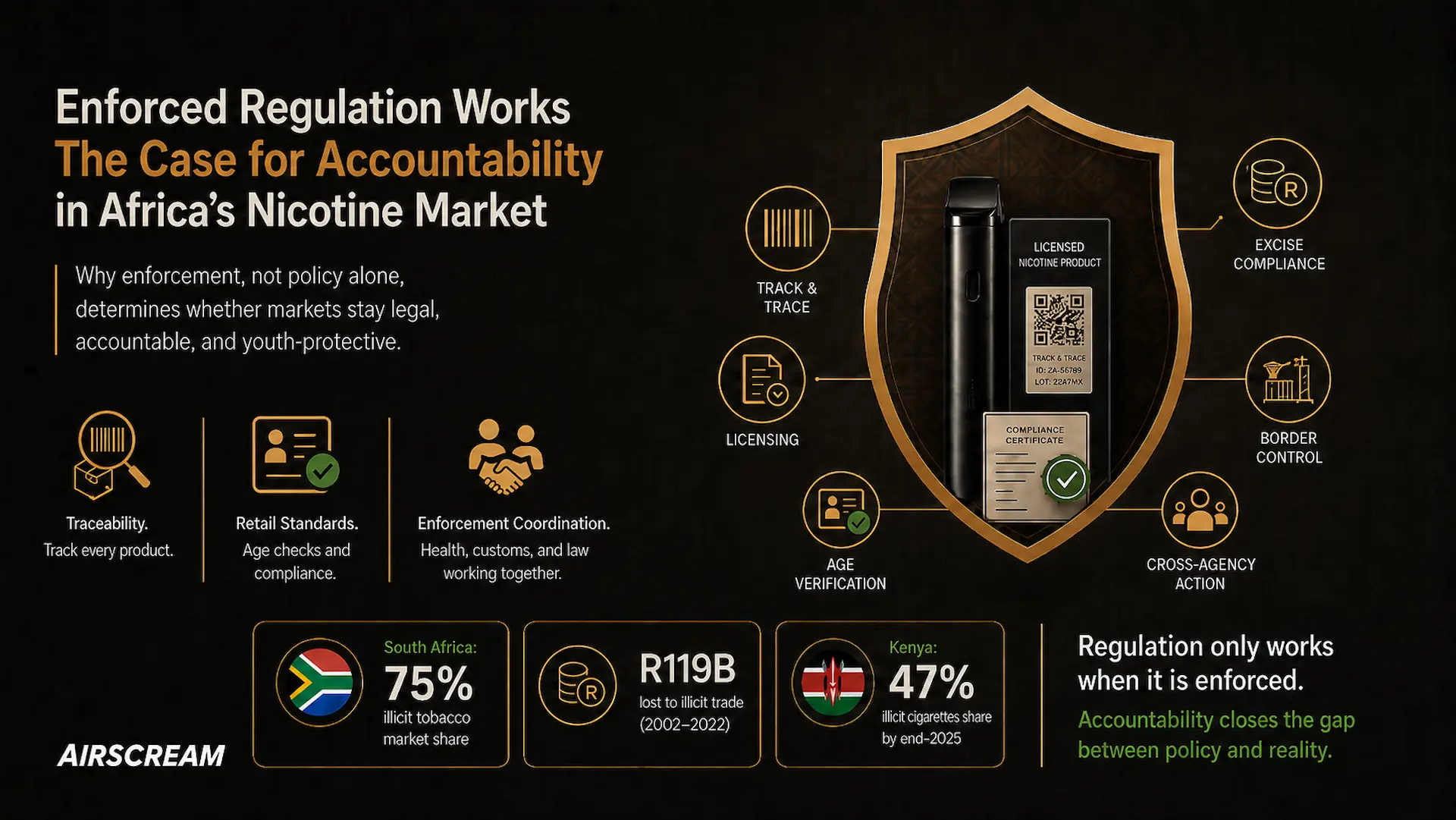
In South Africa, the continent’s most mature vaping market, illegal tobacco products now account for an estimated 75% of total market share, sold in three out of every four stores. Between 2002 and 2022, the South African Revenue Service lost approximately R119 billion in excise and VAT revenue to illicit trade. In Kenya, the situation is deteriorating faster still: British American Tobacco Kenya reported that illicit cigarettes captured 47% of total domestic consumption by end-2025, up sharply from 37% in 2024 — a 10-percentage-point surge in a single year, translating into an estimated KSh 12 billion in annual lost tax revenue. In Nigeria, no specific regulatory framework for electronic nicotine delivery systems (ENDS) exists at all, even as vaping devices flood urban markets in Lagos, Abuja, and Port Harcourt, often without age restrictions, safety standards, or ingredient disclosure.
These are not abstract statistics. They represent the compounding consequence of a regulatory environment where legislation exists, but enforcement does not, and where the absence of enforceable standards creates a structural incentive for the grey market to flourish.
The Illicit Trade Problem Is a Regulatory Failure
The scale of illicit trade across sub-Saharan Africa is not primarily a function of consumer demand for illegal products. It is a function of regulatory arbitrage: where compliant, tax-paying businesses operate at a price disadvantage relative to unregulated competitors, and where enforcement capacity is insufficient to correct the imbalance.
In Kenya, industry analysis suggests the tax differential between legal and smuggled cigarettes is at least 50% compared to some neighbouring countries. Most illicit products enter from Uganda, sometimes rerouted via South Sudan. Authorities have seized and destroyed nearly six tonnes of smuggled nicotine products (including vapes shaped like teddy bears) at Eldoret International Airport between 2024 and 2026 alone. These are not artisanal smuggling operations; they are sophisticated supply chains targeting Africa’s youngest consumers.
In South Africa, the Parliamentary Portfolio Committee on Health concluded its extensive public hearing process on the Tobacco Products and Electronic Delivery Systems Control Bill (B33-2022) in August 2025, with oral submissions from 48 stakeholders ranging from tobacco industry actors and hospitality groups to academic researchers and civil society organisations. The bill, in legislative development since 2018, proposes mandatory plain packaging, bans on point-of-sale display, excise tax frameworks, and for the first time, formal regulation of electronic nicotine delivery systems. During those hearings, a recurring concern raised by vaping industry participants was not opposition to regulation itself, but anxiety that an inadequately enforced bill would simply accelerate the growth of the illicit market. As Asanda Gcoyi, CEO of the Vapor Product Association of South Africa, stated in response to the bill’s parliamentary progress: ‘The industry is hoping for regulation. We must be regulated.’
R119B
Lost to illicit tobacco trade in South Africa, 2002–2022 (excise + VAT)
Source: University of Cape Town, Research Unit on the Economics of Excisable Products, BMJ Open, 2024
Enforcement Is Not Optional, It Is the Policy
There is instructive precedent from within the region. Following Kenya’s introduction of digital track-and-trace excise stamps and an electronic cargo tracking system after 2010, tax compliance increased by approximately 45% by 2014, and excise revenues grew by roughly 20% over the two-year period from 2013 to 2015. The lesson is straightforward: regulatory infrastructure, not just regulatory intent, determines whether a market functions legally or not.
The Global State of Tobacco Harm Reduction 2024 (GSTHR 2024), a biennial landmark report co-authored by experts in harm reduction, data science, and economics, found that across Africa, 38 of 48 sub-Saharan countries have no specific laws regulating the use or sale of nicotine vaping products. For those five countries that do allow vaping under law, enforcement remains highly variable. The report concluded that appropriate, accessible, and affordable safer nicotine products, supported by product regulation, could help create a smoke-free Africa — and that, unlike most tobacco control interventions, this can be achieved at minimal cost to governments.
In Nigeria, the House of Representatives Ad-hoc Committee on Drugs and Illicit Trafficking confirmed in February 2026 that lawmakers are moving to review the National Tobacco Control Act that has been in force since 2015, because existing legislation was designed for traditional tobacco products and does not adequately contemplate electronic cigarettes and vape devices. The committee’s chairman, Hon. Timehin Adelegbe, stated that gaps in the current legal framework allow harmful, unverified products to enter through regulatory cracks, particularly at Nigeria’s borders. Customs authorities disclosed the seizure of over 230 forty-foot containers of illegally imported pharmaceuticals and tobacco-adjacent products in the preceding 12 months.
What Meaningful Enforcement Actually Requires
Effective regulation of the nicotine category particularly modern nicotine products including vaping devices, heated tobacco and nicotine pouches, requires three interconnected elements that are currently absent or underdeveloped across African countries.
First, traceability infrastructure. Products entering the market must be identifiable from manufacture to point of sale. The WHO’s Illicit Trade Protocol, which establishes mechanisms for track-and-trace systems and mandated licensing, has been ratified by multiple African nations but remains operationally under implemented. A Research Square policy analysis published in February 2026 identified five structural gaps in Nigeria’s tobacco control architecture specifically: fragmented institutional authority; absence of a central product regulator; weak supply-chain control; inadequate protection from industry interference; and a regulatory vacuum for emerging nicotine products.
Second, age-verification and point-of-sale standards. For example, Kenya’s Tobacco Control Amendment Bill 2024, stalled in the Senate as of mid-2025 despite being first introduced in July 2024, proposed, for the first time, mandatory age verification at retail, prohibitions on online sales to minors, restrictions on influencer marketing, and requirements for child-proof packaging on nicotine pouches and vaping devices. These are not radical proposals. They are the baseline infrastructure of a functioning regulated market. Kenya’s Harm Reduction Society has noted that vaping products have existed for over 20 years, yet Kenya still has no basic law preventing their sale to under-18s.
Third, cross-agency coordination. The Kenyan scenario illustrates the cost of siloed enforcement: smuggled products enter through land borders at Isebania, Namanga, Loitoktok, Taveta, and Lunga Lunga, while oversight responsibility is fragmented across health, customs, and law enforcement agencies. Effective enforcement demands coordinated institutional frameworks — a lesson that Nigeria’s emerging legislative reform process is beginning, with cooperation agreements between NAFDAC, the NDLEA, and the Nigeria Customs Service.
AIRSCREAM’s Position
AIRSCREAM operates from a straightforward premise: we do not benefit from regulatory ambiguity, and we do not seek it. As the leading vaping brand in South Africa, a market that has, over the past decade, seen the full consequences of an enforcement gap, we understand what happens when compliant businesses and unregulated grey-market operators compete on unequal terms. The consumer loses. The government loses tax revenue. And the legitimate industry loses market share to actors who have no interest in product safety, youth protection, or long-term market sustainability.
We are not in this to argue against regulation. We are here to argue for regulation that works, that is enforceable, that is grounded in product-specific evidence, and that closes the gap between legislative intent and commercial reality. We operate only in markets where we can do business transparently and with full regulatory compliance. We choose our distribution and retail partners on the same basis.
Regulation only works when enforced. That is not a criticism of any government’s intentions. It is a statement of structural fact, and an invitation to build the systems that make enforcement possible.
Sources:
1. South African Parliament, Portfolio Committee on Health Media Statements, February 2025 & August 2025. parliament.gov.za
2. University of Cape Town, Research Unit on the Economics of Excisable Products (REEP). BMJ Open, March 2024. Vellios & van Walbeek.
3. British American Tobacco Kenya PLC, Annual Financial Results 2025. The Star Kenya, March 2026.
4. Global State of Tobacco Harm Reduction 2024 (GSTHR 2024). Knowledge Action Change, London.
5. Research Square: ‘Strengthening Tobacco Control Enforcement in Nigeria: A Policy and Regulatory Analysis Supporting an Expanded Mandate for NAFDAC.’ February 2026.
6. Nation Africa / Daily Nation: ‘From smoking to vaping: Kenya’s new public health challenge.’ April 2025.
7. Capital FM Kenya: ‘Delays to tobacco bill fuel misinformation on safer nicotine products.’ May 2025.
8. Bhekisisa: ‘How Big Tobacco stalls SA’s smoking and vaping law.’ November 2025.
9. The Guardian Nigeria / Meiza.ng: ‘Reps to review Tobacco Control Act over emerging vape products.’ February 2026.
10. Federal Ministry of Health Nigeria, National Tobacco Control Enforcement Plan. August 2024.
11. ICAIE: ‘Why illicit cigarettes, nicotine pouches, and illegally-manufactured tobacco products continue to be lucrative.’ April 2026.