News
Youth Protection in Vaping: What Actually Works?
29 May, 2026
Audience: Regulators, B2B Partners, Consumers, African Market Focus
Reading time: ~8 minutes
Let’s get one thing out of the way first: no responsible brand in the nicotine industry wants children vaping. Not AIRSCREAM. Not any brand that intends to still be operating in five years. Youth protection is not a PR talking point for us. It is a baseline of ethical operation, full stop.
But wanting children not to vape and actually achieving that goal are two very different things. Because the evidence across multiple countries, including South Africa, is telling us something uncomfortable: some of the most popular policy responses to youth vaping are not working nearly as well as we hoped. And some of the measures that do work are still waiting to be implemented in the African markets that need them most.
So let’s talk about what the research actually says. What works, what doesn’t, and what Africa needs to do now while the window to get this right is still open.
First: The Honest Picture From South Africa
South Africa is the most mature vaping market on the African continent, and it is also home to some of the most alarming youth vaping data anywhere in the world right now.
A landmark study published in The Lancet’s eClinical Medicine in late 2024, led by researchers from the University of Cape Town (UCT) and Utrecht University, surveyed over 25,000 high school learners across 52 fee-paying schools in eight of South Africa’s nine provinces. The findings were, as the researchers themselves put it, alarming: 16.8% of surveyed students were currently using e-cigarettes, with the proportion rising sharply by grade from 9% among Grade 8 learners to an average of 29.5% among Grade 12 pupils. More striking still, 38.3% of current vapers reported vaping every day, and more than half said they vaped more than four days per week.
A separate 2024 study found that close to 37% of urban high school students across eight provinces had vaped at least once, with one in six reporting use in the past 30 days. Researchers described it plainly as a ‘vaping crisis.’ UCT’s Samantha Filby, one of the lead researchers, identified a particularly jarring detail in her field reporting: vaping products were being delivered directly to teenagers via mainstream grocery delivery apps including Checkers Sixty60 and UberEats, with no age verification at point of delivery.
This is not a hypothetical problem or a projection. It is happening now, in an unregulated market, and it is getting worse precisely because the regulatory framework to address it has been stalled.
What the Evidence Says Actually Works
Here is where the conversation gets more nuanced than the headlines usually allow. A systematic review published in the American Journal of Preventive Medicine analysed 30 studies examining the effectiveness of different regulatory strategies for reducing youth vaping. Its findings are instructive and somewhat counterintuitive.
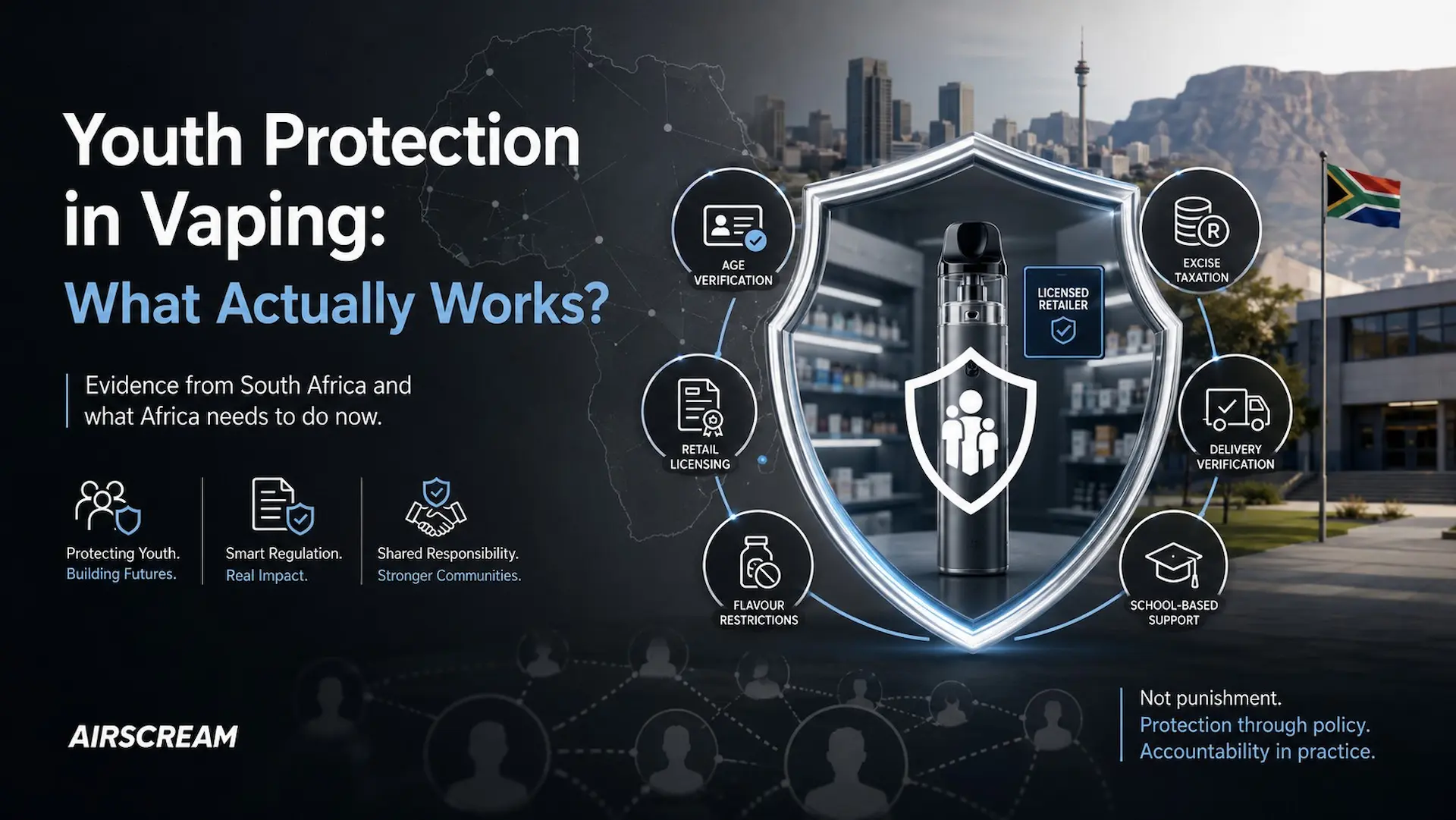
Age restrictions were the most commonly implemented measure across studies, but the review found insufficient evidence to confirm their effectiveness on their own when unaccompanied by enforcement. In other words, passing a law that says ‘you must be 18 to buy a vape’ achieves very little if nobody checks. Age verification requirements without enforcement infrastructure are essentially decorative policy.
The measures with the strongest evidence behind them were flavour restrictions, mandatory retail sales licences, and excise taxation. Flavour bans matter because research consistently shows that flavours are a primary driver of youth initiation: remove the cotton candy and blue raspberry, and vaping loses a significant part of its appeal to teenagers who have never smoked. Retail licensing matters because it gives authorities a mechanism to revoke operating rights from sellers who repeatedly sell to minors, creating real commercial consequences for non-compliance. And taxation matters for the same reason it matters with alcohol and cigarettes: price sensitivity is higher among young people than adults.
The US Centers for Disease Control and Prevention (CDC), in its guidance on protecting youth from vaping harms, is also clear on one point that many African policymakers have not yet internalised: there is no evidence that laws punishing young people for possession or use of tobacco products reduce youth vaping. Criminalising the child does not fix the supply problem. Holding retailers and brands accountable does.
The Social Supply Problem
Here is the part that keeps researchers up at night, because it is genuinely hard to solve with any single regulation.
A 2024 qualitative study published in PMC (National Library of Medicine) examining how underage adolescents access vaping products in New Zealand found that while some teens do buy directly from retailers, the majority of underage access happens through social supply. Friends. Older siblings. Proxy buyers. Someone outside the shop who looks legal. This route of access is not stopped by age verification at the retail counter, because the product never reaches the counter in the hands of a minor.
The same pattern appears in a 2025 study published via PubMed on e-cigarette access and age verification across adolescents, young adults, and adults in the US. It found that most 13 to 17 year olds who use e-cigarettes obtained them not from retailers, but from someone they know. Retail crackdowns, while important, are therefore only part of the picture. The other part involves reducing the overall availability and appeal of the product in youth social environments, which is where flavour restrictions, marketing bans, and broader cultural de-glamourisation come in.
In South Africa’s context, the UCT study’s finding that vaping is more common in co-educational schools, higher-grade classes and (perhaps counterintuitively) lower-fee schools suggests that availability and peer norms are powerful drivers. Youth vaping in South Africa is not simply a wealthy suburb phenomenon. It is moving through school communities rapidly and broadly.
What Africa Needs to Do Now
South Africa’s Tobacco Products and Electronic Delivery Systems Control Bill (B33-2022) contains several of the right building blocks. It proposes banning online sales of vaping products (which would address the delivery app loophole), restricting sales near schools, prohibiting advertising targeting youth, and bringing vaping products under a comprehensive regulatory framework for the first time. UCT researchers, public health groups, and the vaping industry association have all called for its urgent enactment.
But legislation sitting in parliament, however well-designed, does not protect any child today. Three practical things can and should happen in parallel.
Retail enforcement now, not later. Mandatory retailer registration and age verification compliance checks do not require a new bill to begin. Local health authorities can increase compliance monitoring at existing retailers with existing powers. The data on retailers routinely waiving age checks is too well documented to leave unaddressed.
Delivery platform accountability. South Africa’s grocery and delivery platforms enabling the purchase of vaping products without age verification at point of delivery is a specific, addressable problem. Platform operators can be required to implement age-gating in their purchase flows and verification at delivery, as a condition of operating in the category. This requires neither a new bill nor a lengthy parliamentary process.
School-based awareness without criminalisation. As the CDC’s evidence review notes, punishing students is not effective. What does work is equipping school counsellors, healthcare professionals and parents with the information to identify vaping, understand its signs, and address the underlying anxiety and social drivers. The UCT study found that a substantial number of students reported continuing to vape to cope with stress, suggesting that mental health support in schools is as relevant as any regulatory measure.
For Kenya and Nigeria, where vaping-specific regulation effectively does not yet exist, the lesson from South Africa’s experience is clear: do not wait until the problem is the size South Africa is managing before acting. The cost of building regulatory infrastructure before a youth vaping epidemic is dramatically lower than the cost of addressing one after it has taken hold. Both countries have the opportunity to design frameworks that include youth protection from the outset, rather than retrofitting it onto a market that has already grown up around the gaps.
AIRSCREAM’s Position
We will be direct. Youth protection is not a competitive advantage for us. It is a minimum standard. We do not market to anyone below the legal age limit in the different markets we operate in. We do not sell through channels that cannot verify age. We choose our distribution and retail partners based partly on their commitment to compliant point-of-sale practice, because we understand that a brand is only as trustworthy as its weakest retail link.
We actively support the enactment of regulatory frameworks, not because regulation is good for our immediate bottom line, but because unregulated markets with no youth protection measures are bad for everyone, including the long-term credibility of the responsible players in this industry.
The evidence is there and the tools exist. What is needed now in Africa is the political will to use them, and the industry accountability to back them up.
Sources:
1. Van Zyl-Smit RN, Filby S, Soin G et al. ‘Electronic cigarette usage amongst high school students in South Africa: a mixed methods approach.’ The Lancet eClinical Medicine, 2024. doi:10.1016/j.eclinm.2024.102432
2. Filby S et al. ‘E-cigarette, cannabis, hookah and tobacco use patterns in fee-paying South African high schools.’ South African Medical Journal, February 2026. samajournals.co.za
3. Bhekisisa Centre for Health Journalism, ‘How Big Tobacco Stalls SA’s Smoking and Vaping Law,’ November 2025. bhekisisa.org
4. Cape Argus / UCT News, ‘Surge in Vaping Among South African Teens Prompts Urgent Calls for Regulation,’ April 2025
5. UCT News, ‘Address SA’s Adolescent Vaping Catastrophe,’ April 2025. news.uct.ac.za
6. The Conversation / Sunday Independent, ‘Alarming Rise of Vaping Among South African Schoolchildren,’ March 2025. theconversation.com
7. American Journal of Preventive Medicine, ‘Regulatory Strategies for Preventing and Reducing Nicotine Vaping Among Youth: A Systematic Review,’ August 2023. doi:10.1016/j.amepre.2023.00313
8. US Centers for Disease Control and Prevention (CDC), ‘Protecting Youth From the Harms of Vaping,’ updated December 2024. cdc.gov/tobacco
9. PMC/NIH, ‘A Qualitative Analysis of How Underage Adolescents Access Nicotine Vaping Products in Aotearoa New Zealand,’ 2024. PMC11417153
10. PubMed, Gaiha SM et al. ‘E-cigarette access and age verification among adolescents, young adults, and adults.’ Addictive Behaviours, February 2025. doi:10.1016/j.addbeh.2024.108193
11. BMJ Open, ‘Effective interventions to prevent youth vaping behaviours: a rapid review,’ January 2025. doi:10.1136/bmjopen-2024-092380
12. AllAfrica.com / Bhekisisa, ‘South Africa’s Tobacco Bill Stalls as Youth Vaping Surges,’ November 2025. allafrica.com
13. PMC, ‘Knowledge, perceptions, and experiences of e-cigarettes among young adults in Cape Town, South Africa.’ PMC11372481