News
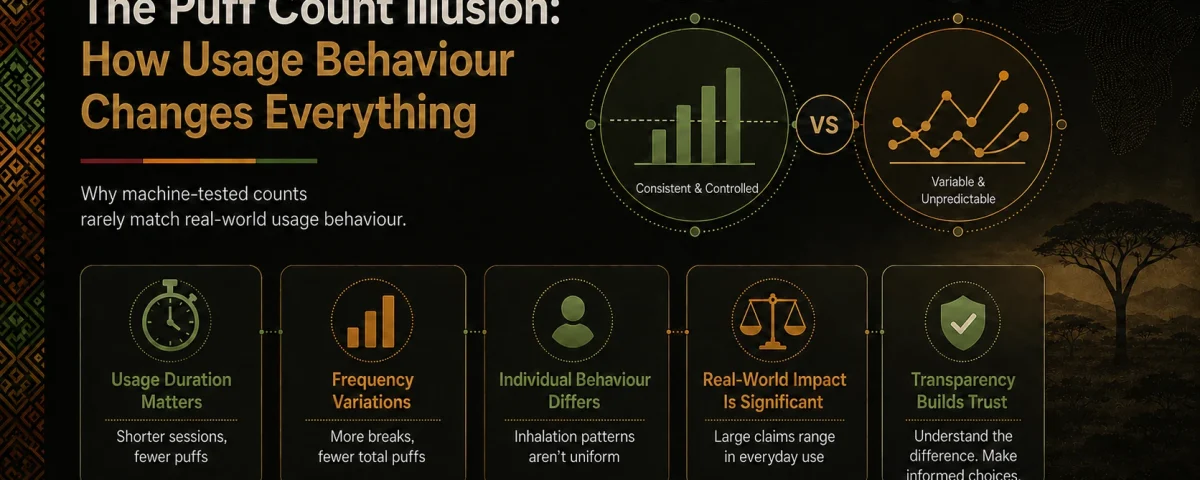
The Puff Count Illusion: How Usage Behaviour Changes Everything
10 June, 2026
Audience: Adult Vapers & Consumer Advocates
Reading time: ~7 minutes
You’ve probably seen it on a box. 3,500 puffs. 6,000 puffs. 10,000 puffs. It’s right there on the packaging, bold and confident, like a promise. And then it runs out in half the time you expected. Sound familiar?
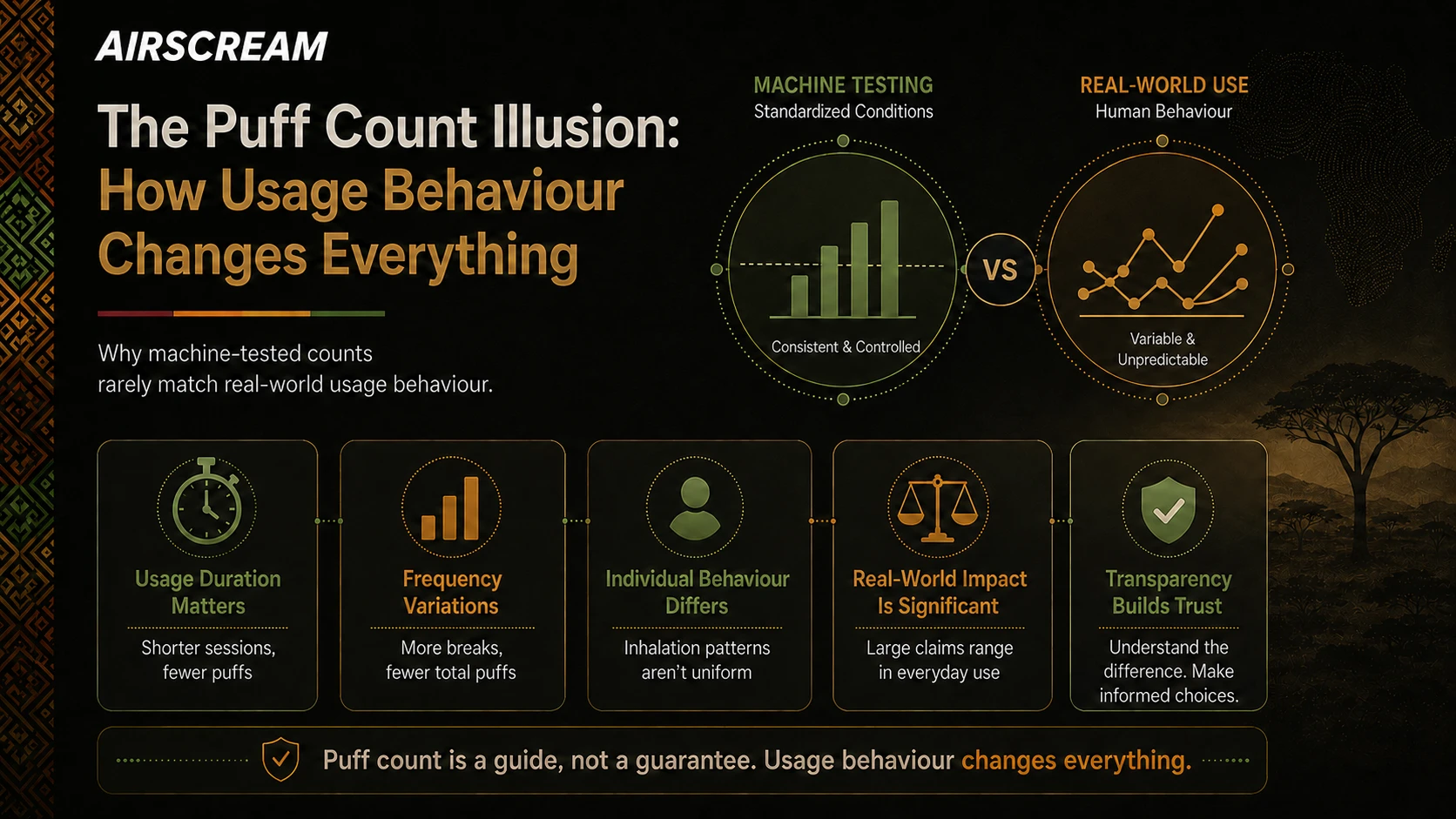
Welcome to the puff count illusion… One of the most misunderstood metrics in the vaping industry, and one that matters far more than most people realise. Because the puff number printed on your device packaging isn’t made up exactly, but it also isn’t really about you. It’s about a machine. And you, as it turns out, vape nothing like a machine.
Understanding the gap between what a puff count says and what it actually means in real life is not just useful for consumers. It changes the conversation around nicotine consumption, product transparency, and what responsible vaping looks like in practice. That conversation is one AIRSCREAM is very much here for.
How Puff Counts Are Actually Calculated
Here is how most manufacturers generate that big, confident number on the box. They attach the device to an automated testing machine that draws a precise, standardised puff (typically one second long, at a fixed airflow and voltage) and counts how many times it can do that before the device is empty. Then they round it up for marketing purposes, and onto the packaging it goes.
The problem is obvious the moment you picture an actual human using a vape. Nobody takes neat one-second puffs at perfectly calibrated intervals. Real vapers take longer, deeper draws, most between two and four seconds, and the volume of vapour (and e-liquid) per puff is therefore significantly higher than what the testing machine used. As MPO Vapes has documented in its transparency reporting, a device might measure hundreds of machine puffs from a given amount of liquid, but in typical human use you get closer to 200 to 300 puffs per millilitre of e-liquid, substantially fewer than lab conditions produce.
A device rated at 12,000 puffs, for example, will realistically deliver somewhere between 8,400 and 9,600 puffs under normal human use, once you account for real-world draw length. That’s a gap of up to 30% before you’ve even considered the most important variable of all: the person doing the vaping.
Your Vaping Behaviour Is More Variable Than You Think
Here is where it gets genuinely interesting. Real-world data on how many puffs people actually take per day reveals an enormous range. Research published via PubMed (National Institutes of Health) on electronic cigarette frequency measurement found a fourfold variation in puff volume between vapers using similar devices. The same puff counter, on two different people, can record wildly different nicotine exposure because one person takes shallow two-second draws and another takes deep five-second ones.
Looking at what vapers themselves report, the picture is equally varied. Users of 20mg nicotine salt devices with mouth-to-lung (MTL) systems typically take between 100 and 200 puffs per day, because high-strength nicotine satisfies cravings efficiently and quickly. Move to a sub-ohm direct-to-lung (DTL) setup with 3mg nicotine, and you might see 500 to 800 puffs a day or more, because each puff delivers far less nicotine per draw. Some enthusiasts report numbers above 1,000 puffs on long, low-nic vaping sessions.
The most robust guide for understanding actual nicotine consumption, experts suggest, is not the puff count at all. It is the volume of e-liquid consumed per day. As one independent analysis puts it, the most reliable benchmark is total liquid consumed: below 2ml per day is light use, 2 to 5ml is moderate, and above 5ml per day begins to indicate heavier consumption. Puff count, by itself, tells you very little without knowing the device type, draw length, nicotine strength, and the individual’s vaping style.
So Why Does This Matter So Much?
Because puff counts are currently one of the primary ways consumers, parents, regulators and even health researchers try to assess how much someone is vaping. And if the metric itself is inconsistently defined, poorly measured and highly variable across individuals and devices, then decisions made based on puff counts alone are being made on shaky ground.
Consider the consumer who buys a 3,500-puff disposable expecting it to last two weeks, based on a calculation of roughly 250 puffs a day. If they are a deep-draw DTL user, it might be gone in five days. If they are a light MTL user on strong nic salts, it might last three weeks. Neither outcome says anything inherently about responsible or irresponsible use. It says everything about how individual behaviour interacts with device design.
Consider the parent who reads that their teenager’s disposable rated at 600 puffs only lasted two days, and concludes this means 300 puffs per day of nicotine consumption. In reality, those could have been very short draws on a weak device shared among multiple people, or very long draws on a strong device used by one. The number 300 means completely different things in those two scenarios.
And consider the researcher trying to track population-level vaping behaviours using self-reported puff counts. A NIH-linked study found that self-reported times-per-day had a Spearman correlation of just 0.58 with actual device-measured puff counts, meaning self-report catches the rough trend but misses a meaningful chunk of variation. In epidemiology, that is a significant source of noise.
What Transparent, Responsible Labelling Should Look Like
The solution is not to abandon puff counts entirely. They are a useful starting point, and standardised testing does allow for at least a rough comparison between devices. But the responsible approach, which AIRSCREAM advocates for across every market we operate in, includes being honest about what those numbers mean and what they do not.
A genuinely transparent product label would tell you the puff count under standardised testing conditions alongside the e-liquid volume in millilitres, the nicotine strength in mg/ml, the approximate puff duration assumed in testing, and a realistic range of expected use based on different usage patterns. That is the kind of ingredient and usage transparency that allows adult consumers to make genuinely informed choices. It is also the kind of transparency that a proper regulatory framework can mandate and enforce, which is exactly why AIRSCREAM supports comprehensive, enforceable product registration and disclosure requirements.
Across our markets in Africa, where ENDS regulation is still developing, one of the biggest risks of an under-regulated category is precisely this: consumers making decisions based on numbers that have no standardised meaning. A grey-market product with a 6,000-puff claim generated from an untested machine under unknown conditions is not equivalent to a product whose puff count was generated under verifiable, disclosed testing protocols. The number on the box looks the same. The accountability behind it is worlds apart.
The Bigger Picture for Adult Smokers
For adult smokers switching to vaping as a harm reduction step, understanding usage behaviour is genuinely important. The evidence for vaping as a cessation tool is well-established: the 2025 Cochrane Living Systematic Review confirms that regulated nicotine e-cigarettes are more effective than nicotine replacement therapy at supporting smoking cessation, with no detected evidence of serious harm in regulated product trials.
But the transition works best when it is informed. A switcher who understands that they need fewer puffs on a high-strength nic salt device than they did cigarettes is more likely to use their device effectively, not just compulsively. A switcher who knows that puff duration matters as much as puff count can calibrate their usage more consciously. And a switcher who has access to a product with clear, honest technical information can make the kind of informed decision that actually supports their long-term health goals.
That is what responsible product design and responsible regulation make possible. And it is why we think the puff count illusion is worth busting, openly and clearly, even though we are a vaping brand. The short-term discomfort of honesty is always a better deal than the long-term damage of misleading expectations.
So next time you see a big number on a box: enjoy the promise. Then adjust for being human.
Sources:
- MPO Vapes, ‘The Truth Behind Vape Puff Counts: How They’re Calculated and Why Transparency Matters.’ mpovapes.com
- RandM Vapes, ‘How Long Does a Disposable Vape Last? Puff Count Breakdown 2025,’ March 2026. vapesrandm.com
- VapeUK.co.uk, ‘How Many Puffs a Day Is Normal? Nicotine Control and Over-Vaping Safety,’ December 2025. vapeuk.co.uk
- Rolling-Buddy.com, ‘How Many Puffs in a Day Is Normal?’ February 2026. rolling-buddy.com
- VapeNexus UK, ‘How Many Puffs of Vape Per Day Is Normal?’ June 2025. vapenexus.co.uk
- PubMed / PMC, ‘Measurement of Electronic Cigarette Frequency of Use Among Smokers Participating in a Randomized Controlled Trial.’ NIH National Library of Medicine. PMC7171268
- Cochrane Library (Living Systematic Review), Lindson N et al., ‘Electronic cigarettes for smoking cessation,’ updated November 2025. doi:10.1002/14651858.CD010216.pub10
- Shisha Vibe, ‘Determining a Safe Vaping Limit: How Many Puffs Per Day?’ November 2025. shishavibe.com