News
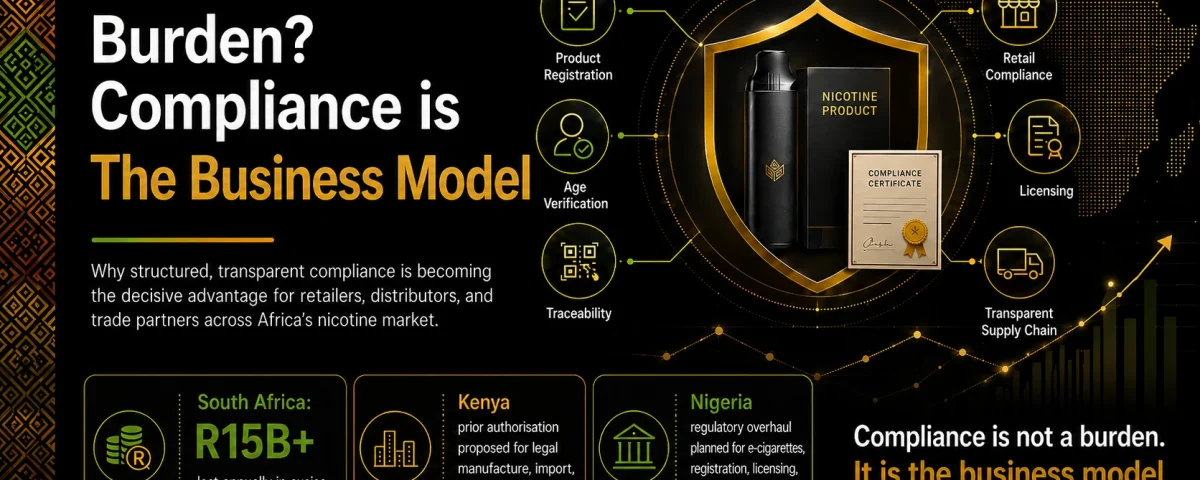
Burden? Compliance Is THE Business Model
26 May, 2026

Audience: Retailers, Distributors, Trade Partners
Reading time: ~7 minutes
If you are a retailer or distributor operating in Africa’s nicotine category such as in South Africa, Kenya, or Nigeria, the next two years will determine which businesses in your space survive and which do not. The deciding factor will not be price. It will not be product range. It will be whether the brands and suppliers you work with can demonstrate, credibly and documentable, that they operate within a structured, transparent, and enforceable framework.
This is not idealism. It is the commercial reality that emerges from every major regulatory tightening cycle in consumer goods markets. And in the African nicotine space, that cycle is now accelerating.
The Regulatory Landscape Is Closing Fast
South Africa’s Tobacco Products and Electronic Delivery Systems Control Bill (B33-2022) completed its public oral hearing process in August 2025, a milestone that the ECigIntelligence industry tracker described as marking one of the lengthiest legislative processes after a bill’s introduction, spanning public consultations from August 2023 through August 2025. The bill, if enacted, will introduce mandatory plain packaging for all tobacco and vaping products, a total ban on point-of-sale display, prohibition of online retail for electronic nicotine delivery systems, age-verification requirements, and the most significant enforcement penalties in South African tobacco control history — including up to 20 years’ imprisonment for manufacturers and importers who violate manufacturing standards, and up to 15 years for those who sell to minors.
These are not proposed penalties for fringe operators. They apply to every actor in the supply chain: manufacturer, importer, distributor, and retailer. The compliance burden does not stop at the brand.
R15B+
Lost annually in excise revenue to South Africa’s illicit tobacco market (2022 data)
Source: University of Cape Town REEP / Business Day, March 2024
In Kenya, the Senate’s stalled Tobacco Control Amendment Bill 2024 that was first introduced in July 2024, proposes that every product in the category require prior authorisation from the Cabinet Secretary for Health before it can be legally manufactured, imported, distributed, stored, or sold. That includes vaping devices, refill containers, and nicotine pouches. Once the bill passes, trading in unauthorised product will not be a grey-area risk management question. It will be a criminal matter.
In Nigeria, the House of Representatives Ad-hoc Committee on Drugs and Illicit Trafficking has confirmed plans to overhaul the National Tobacco Control Act to specifically address electronic cigarettes and vaping products, driven by concern about regulatory gaps being exploited at borders and online. A peer-reviewed study published in BMC Public Health in August 2025 (Weke et al.) found that Nigerian policymakers are already considering how taxation, product registration, and licensing requirements should apply to e-cigarettes, with economic and public health considerations both on the table.
The Illicit Market Is Your Biggest Competitive Risk, Not Your Cheapest Competitor
It is tempting, particularly in markets with historically weak enforcement, to view the illicit trade as simply a lower-priced tier of competition. This is a structural misreading of the risk. The illicit market is not a competitor, it is a liability that attaches to every legitimate business in the category through regulatory contagion.
Here is the mechanism: when a regulatory crackdown occurs and in all three of these markets, crackdowns are coming, enforcement agencies do not distinguish between brands based on intent. They distinguish based on documentation. Which products have registered importers? Which have valid excise declarations? Which can demonstrate age-verification at point of sale? Which have compliant labelling and ingredient disclosure? If a retailer’s shelf contains both compliant and non-compliant product, the retailer’s documented relationship with compliant suppliers is one of the few defences available.
The practical consequence of Kenya’s illicit trade surge is instructive. BAT Kenya reported that illegal products captured 47% of domestic consumption in 2025, a 10-percentage-point jump in a single year, contributing to a 10% decline in net revenue from KSh 25.7 billion to KSh 23.2 billion. The government simultaneously lost an estimated KSh 12 billion in annual tax revenue. The political and enforcement response to that scale of revenue loss will not be gentle. And when enforcement agencies sweep, they do not go looking only for the smugglers. They go looking for the supply chain.
What Compliance as Competitive Advantage Actually Looks Like
AIRSCREAM has built its position as the leading vaping brand in South Africa not despite its compliance posture, but because of it. The commercial logic is straightforward. As legislation tightens, the cost of non-compliance rises exponentially, in legal exposure, in reputational damage, and in lost access to formal retail channels. Brands and distributors that have already invested in compliant infrastructure such as product registration, transparent supply chains, age-gated retail protocols, documented ingredient disclosure and more, face negligible incremental cost from regulatory change. Those that have not face the full restructuring cost, often under deadline pressure.
For retailers, the implications are equally direct. Working with compliant brand partners means:
- Predictable supply — compliant brands do not disappear from shelves when enforcement agencies act
- Reduced legal exposure — documented compliance with age-verification, display standards, and import requirements limits retailer liability under incoming legislation
- Access to formal channels — as regulation formalises the category, non-compliant product will be progressively excluded from legitimate retail environments
- Long-term commercial relationships — brands that survive regulatory cycles are the brands worth building distribution partnerships with
The Africa e-cigarette market context supports the long-term commercial case powerfully. South Africa’s e-cigarette market alone was valued at $167.6 million in 2024 and is projected to reach $410.2 million by 2030, at a compound annual growth rate of 15%. The MEA region is forecast to grow from $162 million in 2025 to $423 million by 2031, at a CAGR of 17.3%. This is a market in structural growth. The question is which participants capture that growth — those operating inside a durable compliance framework, or those operating in a grey zone that is being actively narrowed by policymakers across all three markets.
AIRSCREAM’s Partner Standards
AIRSCREAM is deliberate about who we work with. In a regional market that faces real challenges around transparency in financial transactions and partner accountability, we apply rigorous standards to every distribution and retail partnership we enter. We work only with partners who operate with documented business structures, verifiable compliance histories, and transparent monetary exchange. This is not a preference. It is a core condition.
This approach reflects a commercial reality that mirrors the regulatory one: the partners most likely to survive and grow in Africa’s formalising nicotine market are the ones who have already chosen to operate with integrity. We are actively seeking credible, established, compliant distribution partners in Kenya and Nigeria as we expand our regional footprint. If you are building a business designed to last, one that does not depend on regulatory ambiguity to remain profitable, we want to talk.
Compliance is not a burden. It is the business model. And in the market that is emerging across sub-Saharan Africa, it is the only model with a long-term future.
Sources:
- ECigIntelligence: ‘South Africa’s Tobacco and Vapes Bill: where we are and what comes next.’ April 2026. ecigintelligence.com
- South African Parliament, Media Statement: ‘Health Committee Concludes Public Hearings on Tobacco Bill.’ August 2025. parliament.gov.za
- Juta MedicalBrief / News24: ‘New smoking, vaping Bill proposes 20-year sentences.’ September 2024.
- University of Cape Town REEP / Business Day: ‘Failure to end the illicit cigarette trade has cost SA billions.’ March 2024.
- The Star Kenya / The Kenya Times: BAT Kenya Annual Results 2025. March 2026.
- Weke A, Millard C, Holliday R et al. ‘Potential determinant factors of electronic cigarette regulation in Nigeria.’ BMC Public Health 25, 2925. August 2025. doi: 10.1186/s12889-025-24376-7
- P&S Intelligence: ‘South Africa E-Cigarette Market Size & Growth Report, 2030.’ 2024.
- Research and Markets: ‘Middle East and Africa E-Cigarettes Analysis Report 2026.’ February 2026.
- Nation Africa: ‘All you need to know about the new tobacco law.’ October 2024.
- Capital FM Kenya: ‘Delays to tobacco bill fuel misinformation on safer nicotine products.’ May 2025.