News
Smoke, Screens and Perception: Why Smoking’s Cultural Image Deserves a Rethink
23 September, 2026

Smoking has occupied a distinctive place in popular culture for decades. On screen, cigarettes have often been used as shorthand for rebellion, confidence, danger or sophistication.
The detective thinking through a difficult case. The musician backstage. The antihero staring into the distance.
Over time, the cigarette became part of the character. A visual cue so familiar that it is easy to forget the reality behind the image. And that reality is far less cinematic.
Smoking is still part of the picture
Greater awareness of smoking-related disease has not removed cigarettes from popular entertainment.
An analysis by NORC at the University of Chicago, in collaboration with Truth Initiative, examined 152 top box-office films released in 2024. Tobacco imagery appeared in 51% of them, up from 41% in 2023. Researchers recorded 2,858 tobacco-related incidents, a 43% year-on-year increase, with cigarettes accounting for 73% of those incidents.[1]
That does not mean every appearance is actively promoting smoking. Cigarettes can help establish a period, develop a character or reflect a particular social environment.
But repetition matters. For generations, audiences have seen smoking associated with familiar cultural archetypes: rebels, musicians, gangsters, detectives, villains, antiheroes and leading characters.
Over time, those associations can create a cultural identity around smoking that looks very different from its real-world consequences. Entertainment does not determine how every individual behaves. But it can influence what feels normal, familiar or socially acceptable.
A 2022 systematic review and met analysis covering 26 studies found that greater exposure to smoking imagery in films was associated with smoking uptake among adolescents.[2]
That does not mean seeing a cigarette on screen automatically causes someone to smoke. Human behaviour is far more complex. It does mean representation deserves to be taken seriously.
Over decades, cigarettes accumulated a powerful set of cultural associations, often linked to ideas of confidence, independence and defiance. Those associations were shaped by repeated portrayals in film, advertising and popular culture, rather than by the realities of smoking itself.
That is the power of visual language. But familiarity should not be confused with harmlessness.
The reality behind the image
The health consequences of combustible smoking are well established.
According to the World Health Organization, tobacco causes more than seven million deaths globally every year. More than 1.6 millions of those deaths occur among non-smokers exposed to second-hand smoke.[3]
Cigarette smoke contains thousands of chemicals, and smoking is a major risk factor for cardiovascular disease, cancer and respiratory disease. There is nothing glamorous about those outcomes.
In a different era, cultural image of smoking occupied a very different place in advertising, entertainment and perception of everyday social life.
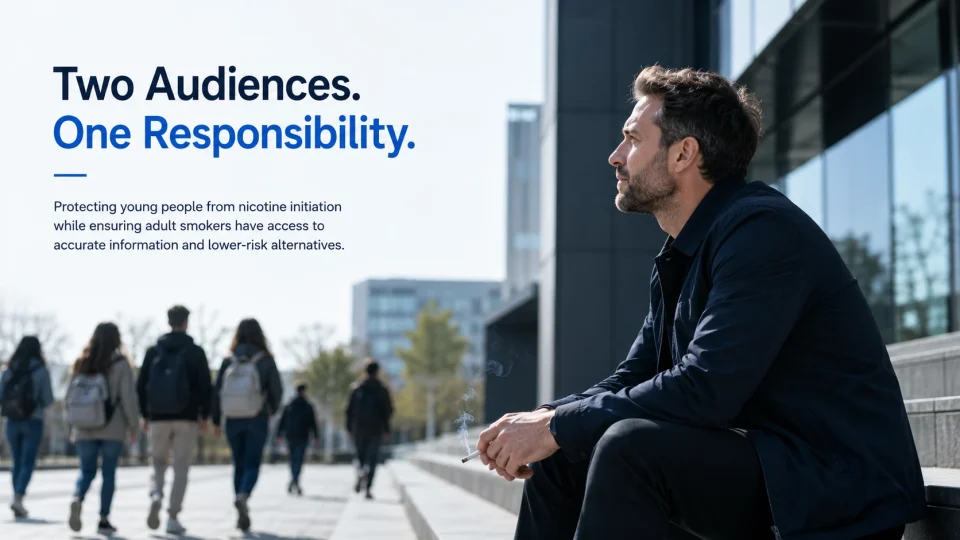
We can understand that smoking is harmful while still recognising the visual language surrounding it: the cigarette after a difficult day, the rebellious character lighting up, or the person standing outside a bar with smoke drifting through the frame.
Culture remembers the image even after our understanding of the consequences has changed.
Changing the conversation
Entertainment does not determine how every individual behaves. But it can influence what feels normal, familiar or socially acceptable.
A 2022 systematic review and meta-analysis covering 26 studies found that greater exposure to smoking imagery in films was associated with smoking uptake among adolescents.[2]
That does not mean seeing a cigarette on screen automatically causes someone to smoke. Human behaviour is far more complex. It does mean representation deserves to be taken seriously.
Over decades, cigarettes accumulated a powerful set of cultural associations, often linked to ideas of confidence, independence and defiance. Those associations were shaped by repeated portrayals in film, advertising and popular culture, rather than by the realities of smoking itself.
That is the power of visual language. But familiarity should not be confused with harmlessness.
Smoking does not need to be “cool”
The answer is not to replace one nicotine product with another cultural symbol. Nor should the smoke-free conversation be about finding a new way to make nicotine look fashionable. The more responsible approach is to separate image from evidence.
For people who do not smoke, not starting remains the clearest choice. For adults who already smoke, stopping combustible cigarette use should remain the priority, supported by appropriate cessation and other healthier options available within their market and regulatory environment.
And for the wider culture, perhaps it is time to reconsider the image we have inherited. Smoking may have spent decades being a cultural symbol, but our lifestyle is evolving.
Sources
- NORC at the University of Chicago and Truth Initiative. Tobacco in Films: 2024. Published November 2025.
- Hassanein, Z.M., Barker, A.B., Murray, R.L., Britton, J., Agrawal, S. & Leonardi-Bee, J. Impact of Smoking and Vaping in Films on Smoking and Vaping Uptake in Adolescents: Systematic Review and Meta-Analysis. Health Education & Behavior, 2022; 49(6):1004–1013.
- World Health Organization. Tobacco and nicotine. Fact sheet, updated 26 June 2026.