News
Protecting Young People While Supporting Adult Smokers: These Are Not Opposing Goals
15 August, 2026

The conversation around vaping is often framed as a strict binary protecting young people and supporting adults who smoke. It should not be.
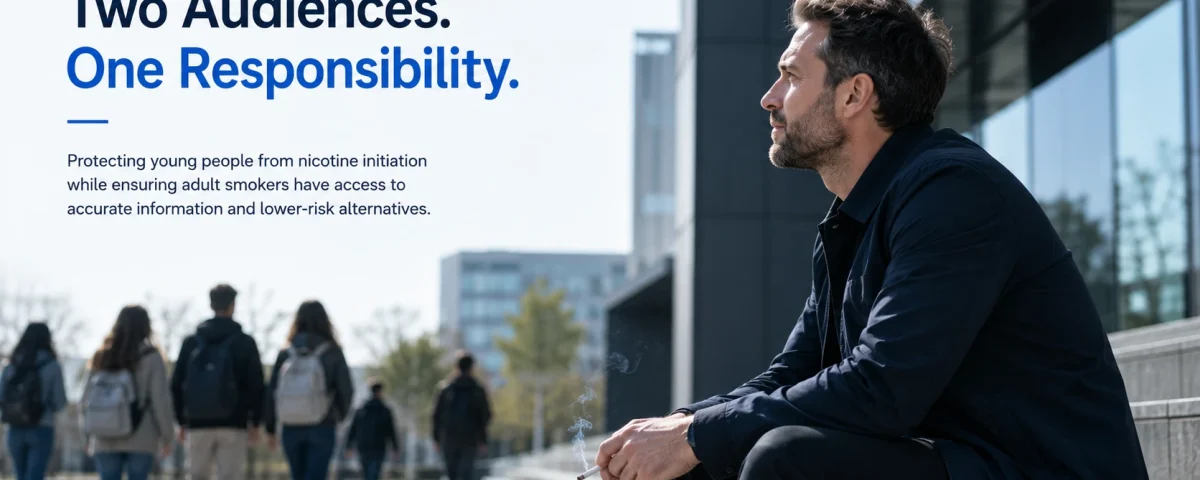
Young people and non-smokers should not start vaping. At the same time, adult smokers should have access to accurate information about the relative risks of smoking and lower-risk alternatives that can help them move away from cigarettes.
These are not opposing goals. They are part of the same fundamental responsibility: reducing avoidable harm through clear, accurate communication tailored to different audiences.
Youth protection requires a clear boundary
The baseline principle is straightforward: vaping products are not intended for children or young people.
The 2026 ASH Smokefree GB Youth Survey found that 19% of 11–17-year-olds had tried vaping and 6% identifying as current vapers
Usage varied significantly by age, from 4% among 11–15-year-olds to 13% among 16–17-year-olds.
Youth vaping appears to have stabilised following a sharp rise between 2021 and 2023, but the issue still requires continued attention.
Young people also report substantial exposure to vaping promotion. Among 11–17-year-olds who are aware of vapes, 75% said they had seen some form of promotion in 2026, with shops in the most commonly reported location.
Protecting young people therefore requires more than a passive age disclaimer. It relies on responsible marketing, appropriate product presentation, effective age verification, and explicit messaging that nicotine is addictive and should not be initiated by young people.
Crucially, however, youth-protection messaging should not project the false impression that vaping and smoking carry identical levels of risk.
Youth protection and accurate risk communication can coexist
Public understanding of relative risk remains a concern.
ASH’s 2026 data found that 62% of young people believed vaping was as harmful as, or more harmful than smoking. Among adults who smoke, 52% held the same view.
That misunderstanding matters because the evidence does not treat smoking and vaping as equivalent.
Young people need to understand that vaping is not risk-free and that they should not start. Adults who smoke also need to understand that continuing to smoke carries persistent global health footprint than switching completely to vaping.
Responsible communication should discourage inappropriate use without obscuring the relative risks faced by adults who continue to smoke.
Smoking remains the greater health concern for adults
The need for accurate risk communication becomes particularly clear when considering the continued health impact of smoking.
The World Health Organization identifies tobacco use as a major risk factor for cardiovascular disease, as well as cancer, stroke, and respiratory disease. Tobacco is responsible for more than seven million deaths globally each year, including deaths linked to second-hand smoke.
The health risks of smoking have been communicated for decades, yet smoking continues.
In Great Britain, ASH estimates that around 11% of adults still smoke.
Awareness of risk does not always translate directly into behaviour change. Nicotine is highly addictive, and smoking can become embedded in routines and patterns of behaviour that make quitting difficult.
For adults who continue to smoke, responsible communication should therefore go beyond repeating that smoking is harmful. It should also explain the relative risks of available alternatives.
Vaping is not risk-free, but it is not the same as smoking
Vaping should not be catergorised as harmless. Its long-term effects continue to be studied, and nicotine itself is addictive. The lowest risk option is not to smoke or vape.
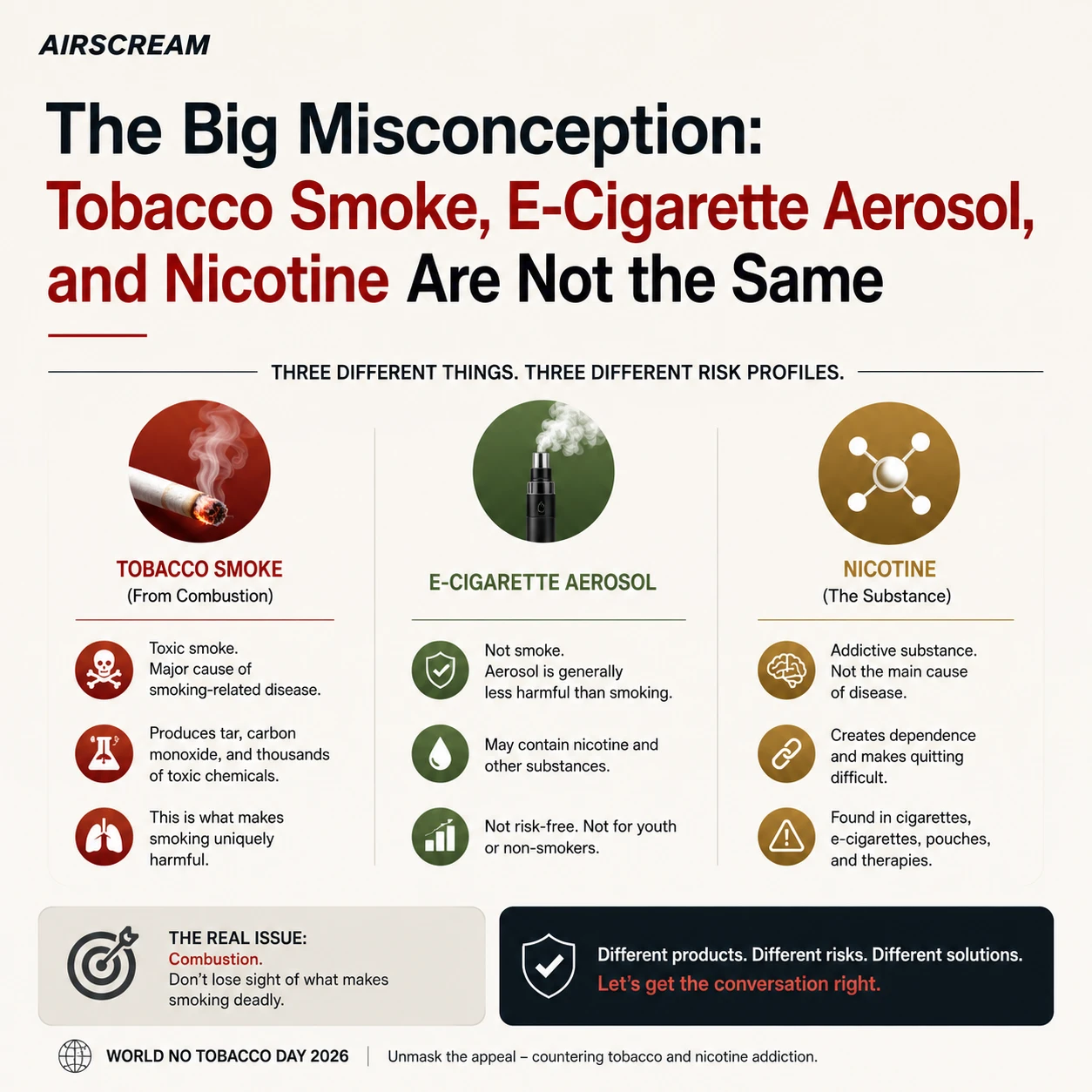
However, the risks of vaping and smoking are not equivalent.
The NHS states that nicotine vaping is less harmful than smoking and exposes users to fewer toxins and at lower levels than cigarettes.
The distinction lies largely in the way the products work.
Cigarettes burn tobacco. Combustion produces thousands of chemicals, including substances such as tar and carbon monoxide that contribute to serious diseases including cancer, heart disease, and stroke.
Vapes do not burn tobacco. Instead, they heat an e-liquid to produce aerosol. Because vaping does not involve tobacco combustion, users are exposed to fewer toxic substances than with cigarette smoking.
For people who do not smoke, this relative-risk difference is not a reason to start vaping.
For adults who already smoke, however, the comparison is relevant. Current UK health guidance recognises that switching completely away from cigarettes can reduce harm.
Complete switching matters
The benefit of switching depends on moving away from cigarettes rather than dual-using both products. The NHS states that people gain the full health benefits of vaping as an alternative to smoking only when they stop smoking completely.
There is also growing evidence that nicotine vapes can support smoking cessation.
An updated Cochrane review published in August 2026 examined 80 randomised controlled trials involving almost 30,000 participants. It found high-certainty evidence that nicotine e-cigarettes resulted in higher smoking-cessation rates than nicotine-replacement therapy such as patches and gum, equivalent to around four additional people quitting for every 100 treated.
This evidence does not support indiscriminate promotion of vaping. It reinforces the need to distinguish between different audiences and purposes.
A product that should not be taken up by young people or non-smokers can still play a role for adults who are trying to stop smoking.
Different audiences require different responsibilities
The 2026 adult data reinforce why vaping should remain closely connected to smoking rather than being positioned as a general lifestyle product.
Around 10% of adults in Great Britain currently vape. Among them, 60% are former smokers and 32% continue to smoke. Only 8% of current adult vapers have never smoked.
That pattern supports a clear distinction in how vaping should be discussed.
For young people, the priority is prevention: limiting access, avoiding youth-oriented marketing and presentation, and making clear that nicotine use should not be initiated.
For adults who smoke, the priority is accurate information about relative risk, smoking cessation and lower-risk alternatives for those who would otherwise continue smoking.
Clear age boundaries help define who vaping products are not for. Accurate risk-communication helps adult smokers understand why moving away from cigarettes matters.
Responsibility means being clear about both sides
The vaping debate is less useful when it is reduced to whether vaping is simply “good” or “bad.”
For a young person or an adult who does not smoke, starting to vape introduces unnecessary exposure to nicotine and other risks.
For an adult who already smokes, continuing to smoke carries substantial and well-established health risks. In that context, switching completely to a less harmful alternative can reduce risk.
Young people and non-smokers should not start vaping. Adults who smoke should be encouraged to stop smoking, and those who would otherwise continue should have access to accurate information about lower-risk alternatives.
Protecting one group does not require withholding useful information from another.
The responsibility is to communicate both messages clearly, accurately, and to the right audience.
That is how youth protection and support for adult smokers can work towards the same goal: reducing avoidable harm.
Sources
- Action on Smoking and Health (ASH), Use of vapes and other novel tobacco and nicotine products among young people in Great Britain, 2026
- Action on Smoking and Health (ASH), Use of vapes and other novel tobacco and nicotine products among adults in Great Britain, 2026
- NHS Better Health, Vaping to quit smoking and Vaping myths and facts
- Cochrane, Vapes help more people quit smoking than other methods, 26 August 2026
- World Health Organization, Tobacco and nicotine, 26 June 2026